Job Application Tracker
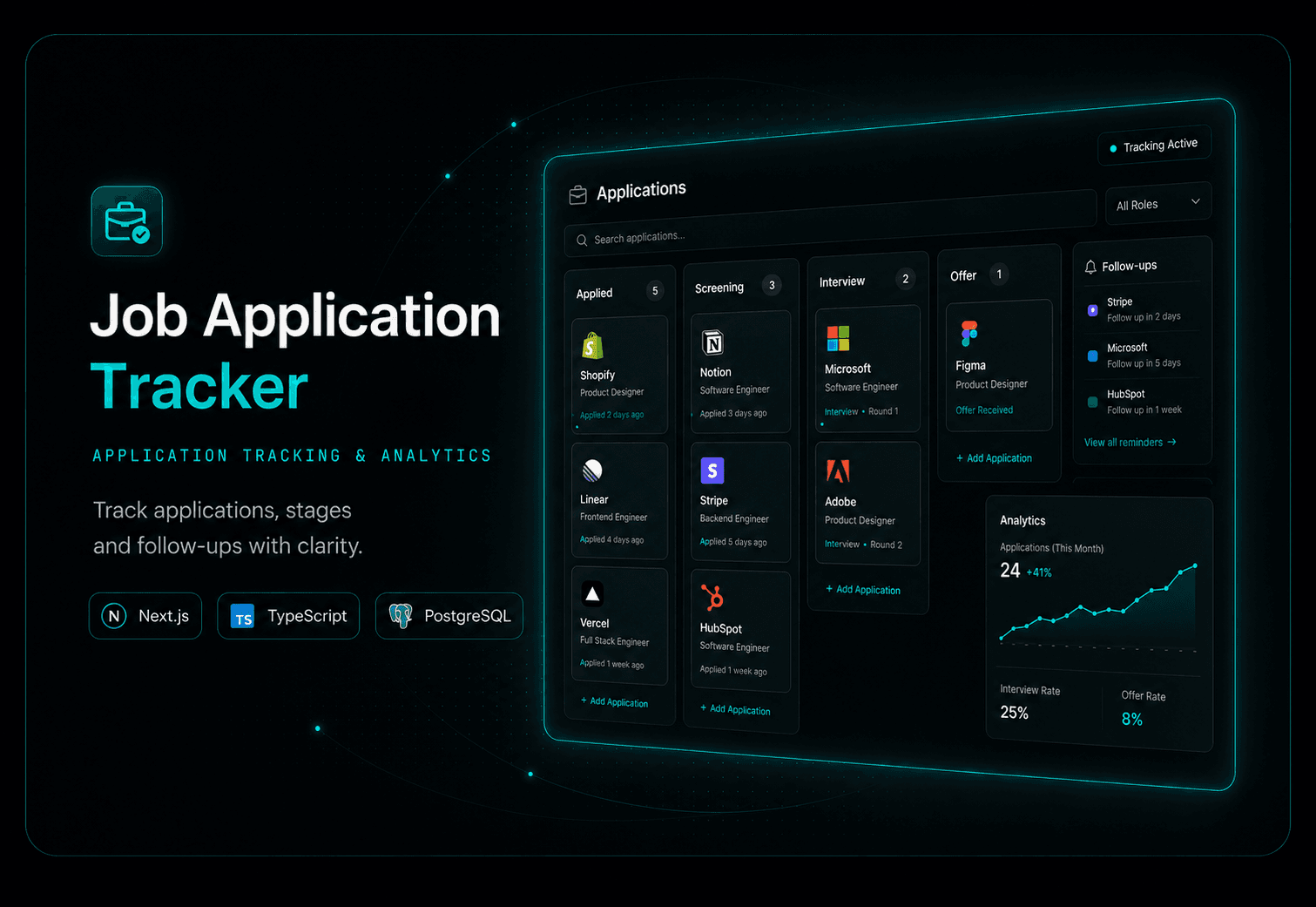
A focused SaaS dashboard that helps job seekers organize applications, reusable information, follow-ups, goals and analytics in one place.
A job search becomes messy faster than people expect
Applicants are often juggling roles across job boards, saved links, spreadsheets, notes and inboxes. That makes it easy to lose track of where they applied, when to follow up and whether their search is actually moving forward.
Job seekers often track roles across job boards, notes, bookmarks, spreadsheets and email threads.
The same portfolio links, profile URLs, education details and answers are copied again and again across forms.
Without reminders, stage tracking and simple metrics, it is easy to miss follow-ups or lose momentum.
A calm command center for the application journey
Job Application Tracker gives users a central place to save reusable information, track every application and measure progress. The workflow keeps the job search practical: capture the role, move it through the pipeline, remember the next action and understand momentum through simple metrics.
A structured board for applications, goals and follow-ups
Everything a serious job search needs in one workflow
Reusable blocks store GitHub, LinkedIn, portfolio, resume links, education details and common application answers.
Users can save company, role, URL, country, source, salary, notes, dates and current application status in one place.
Applications move through stages like Saved, Applied, Interview, Technical Test, Offer, Rejected and Follow-up.
Daily application targets help job seekers stay consistent without needing to manage a separate habit tracker.
Follow-up dates help users remember when to contact recruiters or hiring managers after applying.
Simple metrics show total applications, monthly progress, interview rate, success rate, pending roles and daily progress.
Product planning and full-stack architecture
I worked on the product idea, feature planning, user flow and SaaS architecture. The focus was to design a tool that feels genuinely useful for people applying to multiple roles every week without turning the job search into a heavy admin system.
Built around the real job-search data model
The product was planned as a modern Next.js SaaS with a PostgreSQL and Prisma backend. The data model supports application records, reusable information blocks, status stages, follow-up dates, daily goals, notes and analytics calculations.
Making a productivity tool feel focused, not stressful
Useful without becoming heavy
Job seekers need structure, but a complicated productivity tool can become one more thing to maintain.
Focus the product around the highest-value actions: save reusable info, add applications, move stages, set goals and review progress.
Analytics that motivate
Too many numbers can make a stressful job search feel even more overwhelming.
Keep metrics clear and encouraging: daily goal completion, total applications, interview rate, monthly progress and pending roles.
Modeling the real workflow
A job search is not just a list of companies. It includes notes, follow-ups, stages, reusable details and status history.
Design the database around active job-search behavior instead of treating each application as a flat spreadsheet row.
Job Application Tracker became a practical SaaS concept for job seekers who want a more serious and consistent search process. It reduces repeated manual work, keeps applications organized, helps users follow up on time and gives them a clearer view of progress across the whole application journey.
What I learned
A job search is not just a list. It is a workflow with goals, reminders, emotions and small repeated tasks. This project strengthened my experience with SaaS planning, database modeling, Kanban workflows, user goal tracking and analytics-driven dashboard design.
What's next
A focused SaaS dashboard for a better job search
A practical productivity system that helps job seekers replace scattered spreadsheets with one organized application workflow.