FlowDeck
Order workflow management for Shopify merchants — turning a messy order list into a visual, drag-and-drop fulfilment board.
Order tracking outgrows the default tools fast
Shopify's default order list works — until order volume and team size grow. Tracking fulfilment stage by stage, by hand, stops scaling long before the business does.
Merchants lose track of which orders are pending, packed, delayed or completed — especially once more than one person touches fulfilment.
Spreadsheets, tags and outside tools plug the gap — adding busywork instead of removing it.
As order volume grows and more people touch fulfilment, tracking it by hand gets harder, not easier.
A board, not a list
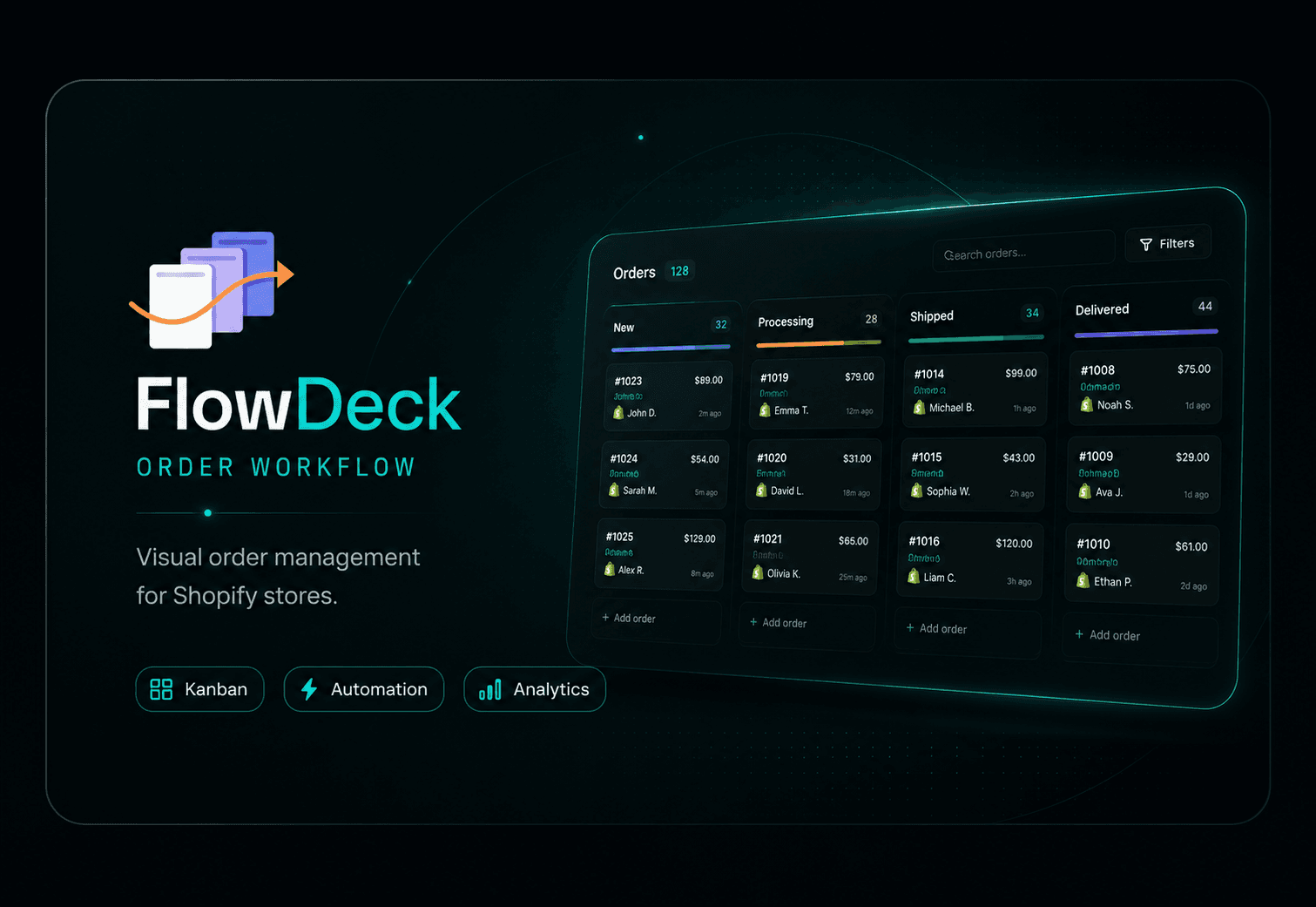
FlowDeck gives merchants a visual order workflow board where orders move between stages by drag and drop. Each board mirrors the merchant's real fulfilment process — simple enough for a small store, flexible enough for one running a full ops team.
Orders move left to right as the team actions them
What merchants actually use
Orders live as cards inside workflow columns — drag one between stages and the whole team sees it move.
Merchants define their own stages — pending, confirmed, packed, dispatched, delivered, returned — to match how they work.
Real store orders flow in from Shopify automatically — no copying data by hand.
Orders advance on their own when a status changes, a tag is added, or a fulfilment condition is met.
The board updates live as order data and workflow status change, for everyone looking at it.
A dashboard surfaces order movement, bottlenecks and fulfilment progress at a glance.
Product builder & technical lead
Planning, product structure, development direction and Shopify app implementation — end to end, from concept to App Store.
Built as a full-stack public app
A clean, fast merchant-facing frontend backed by services handling Shopify API communication, order sync, workflow data and automation. Performance, reliability and Shopify compliance were priorities from day one.
Staying simple while staying flexible
Simple, but flexible
Order workflows get complex fast — the experience had to stay clean and easy to understand as flexibility grew.
Keep the board simple by default, and let merchants layer in custom stages only when they need them.
Shopify's truth vs. FlowDeck's workflow
Syncing Shopify order data with custom workflow states risked confusing Shopify's own order status with FlowDeck's internal stages.
Shopify stays the source of truth for order data; FlowDeck owns only the operational workflow layer on top.
FlowDeck launched as a public Shopify app, giving merchants a more visual and structured way to manage fulfilment. It's gaining visibility on the Shopify App Store, and early merchant feedback is already shaping the roadmap — better automation, SLA tracking, analytics and multi-channel order management.
What I learned
Operational clarity matters as much as any single feature — a simple visual system can change how a team runs its day. Building FlowDeck also sharpened my Shopify app development, workflow automation and real-time interface experience.
What's next
More than a Kanban board for orders
An operational workflow tool built to help Shopify merchants ship orders with more visibility, speed and control.