E-commerce Automation Suite
An event-driven automation platform that connects Shopify with back-office tools to reduce repetitive operational work.
Growing stores get buried under repeated operations work
As order volume grows, teams spend more time updating inventory, sending order emails, exporting data and coordinating between tools. The work is repetitive, error-prone and difficult to scale with spreadsheets or disconnected systems.
Growing stores repeatedly update inventory, send emails, export orders and move data between disconnected tools.
Copying order and inventory data by hand slows fulfillment and increases the chance of stale or incorrect records.
Shopify, back-office tools, CRMs and fulfillment systems often need custom mapping before data can flow reliably.
A Shopify event layer for operations automation
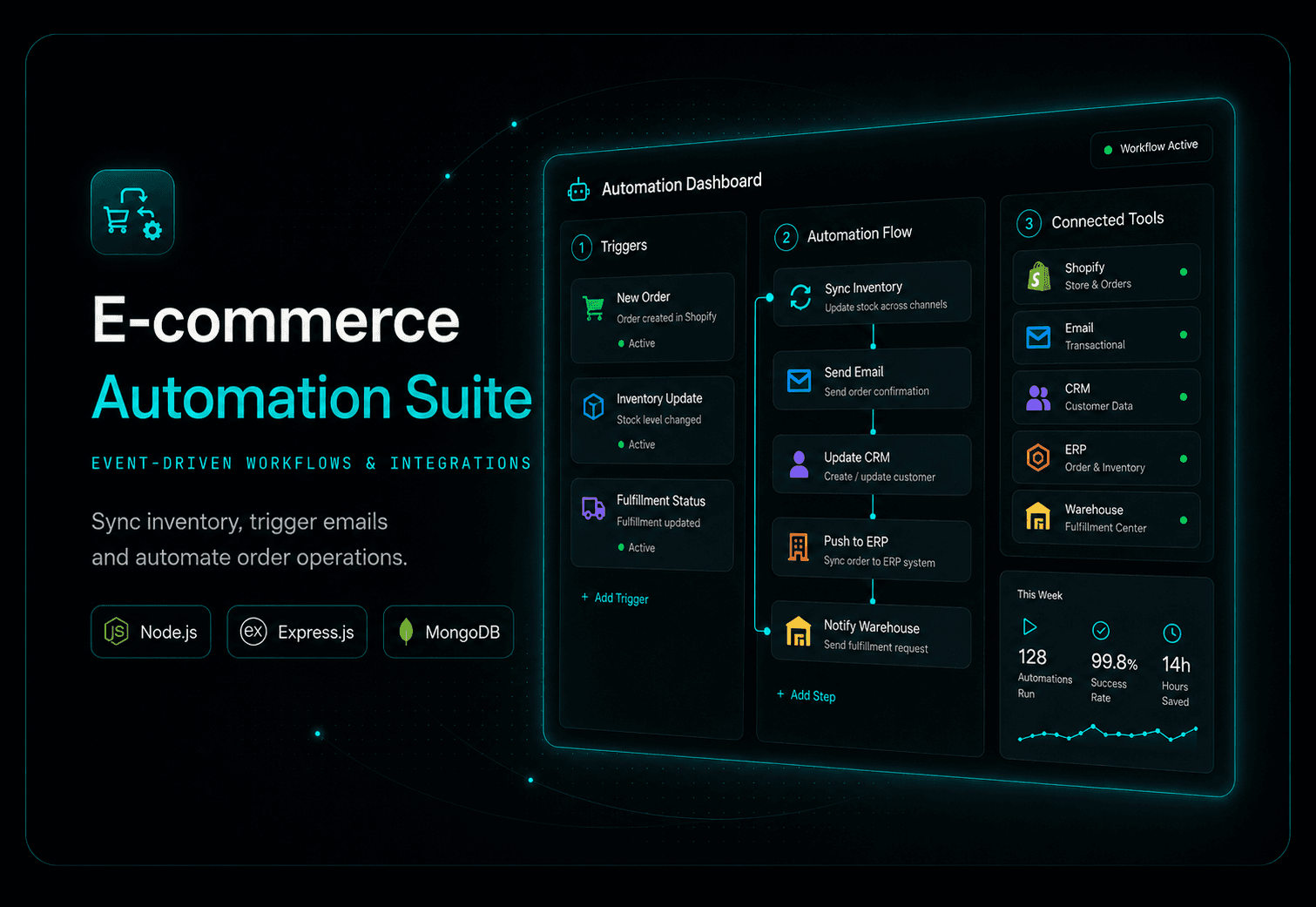
E-commerce Automation Suite listens for Shopify events, checks the merchant's automation rules and performs the correct action across connected tools. A new order, inventory update, fulfillment change or customer action can trigger inventory syncs, emails, data forwarding or internal workflow updates without manual copying.
Shopify events become reliable backend automations
A flexible automation engine for daily commerce operations
The system listens for Shopify events and runs matching actions automatically when orders, inventory or fulfillment data changes.
Inventory data can be synced between Shopify and connected back-office systems to keep stock records aligned.
Order details can be sent to CRMs, ERP tools, fulfillment platforms, dashboards or custom internal systems.
Emails can fire from order status, inventory conditions, fulfillment updates or custom business rules.
Rules can respond to product category, tags, order value, location or other merchant-specific conditions.
Automation logs show what ran, what failed and where the system needs attention so operations stay transparent.
Backend architecture and automation logic
I worked on the product concept, system planning, backend structure and automation logic. The core challenge was building a flexible engine that could receive Shopify events, match saved merchant rules and execute actions across connected tools.
Webhook handling separated from rule execution
The backend separates webhook validation, event processing, rule matching, action execution and logging. MongoDB stores merchants, automation rules, connected tools, event logs and processed order data with enough flexibility for different automation types.
Reliable automation has to be flexible and debuggable
Flexible workflows for different merchants
Each store has its own operations stack, so the product could not be limited to one fixed automation path.
Model rules, events and actions separately so merchants can define conditions and trigger different downstream workflows.
Reliability under real business pressure
Operational automations affect orders, inventory and customer communication, so failed or duplicate events can create real problems.
Separate webhook validation, rule matching, action execution and logging to make processing easier to retry, debug and extend.
Clean data mapping
Shopify order data and external tools often use different fields, payload shapes and naming conventions.
Plan a transformation layer that can normalize Shopify events before pushing data into back-office systems.
E-commerce Automation Suite created a practical automation layer for Shopify operations. It improved how data moves between systems, reduced manual checking and copying, and gave merchants a more consistent way to handle order, inventory and communication workflows as the business grows.
What I learned
Many e-commerce bottlenecks come from disconnected systems, not lack of effort. This project strengthened my experience with Shopify webhooks, API integrations, automation rule design, MongoDB modeling, backend reliability and event-driven systems.
What's next
An automation layer for growing Shopify operations
A backend-heavy system that turns Shopify events into reliable workflows across inventory, orders, email and back-office tools.